

impact@psychopediajournals.com
9988366750
e-ISSN: 3107-8311
International Journal of Global Mental Health, Innovation, Policy, Action, Culture & Transformation

International Journal of Global Mental Health, Innovation, Policy, Action, Culture & Transformation

📢 Latest Update: New special issue call for papers on "Global Mental Health, Innovation, Policy, Action, Culture & Transformation" - Submit by March 31, 2026

📢 Latest Update: New special issue call for papers on "Global Mental Health, Innovation, Policy, Action, Culture & Transformation" - Submit by March 31, 2026

Volume 1, Issue 2 - 2025 (Oct-Dec 2025)

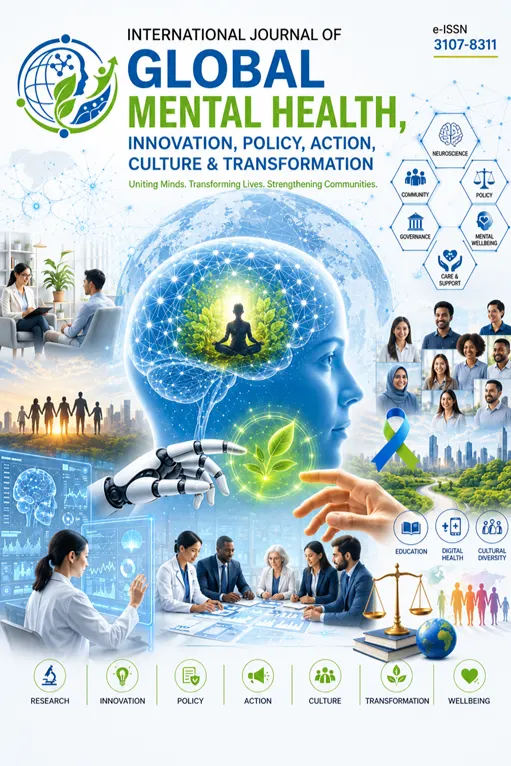
Volume 1 Issue 2 Cover

Issue Details:

Volume 1 Issue 2
Published:Nov 19, 2025

Editorial: Oct-Dec 2025

Welcome to the 2025 issue of International Journal of Global Mental Health, Innovation, Policy, Action, Culture & Transformation. This issue showcases the remarkable breadth and depth of contemporary research across multiple disciplines. From cutting-edge applications of machine learning in climate science to the revolutionary potential of quantum computing in drug discovery, our featured articles demonstrate the power of interdisciplinary collaboration in addressing global challenges.

We are particularly excited to present research that bridges traditional academic boundaries, reflecting our journal's commitment to fostering innovation through cross-disciplinary dialogue. The integration of artificial intelligence with environmental science, the application of blockchain technology to supply chain management, and the convergence of urban planning with smart city technologies exemplify the transformative potential of collaborative research.

As we continue to navigate an era of rapid technological advancement and global challenges, the research presented in this issue offers both insights and solutions that will shape our future. We thank our authors, reviewers, and editorial board members for their continued dedication to advancing knowledge and promoting scientific excellence.

Dr. Aashna Narula
Editor in Chief
International Journal of Global Mental Health, Innovation, Policy, Action, Culture & Transformation

Articles in This Issue

Showing 4 of 4 articles
Research PaperID: impact-00001183Pages 1-10

A Study on Psychological Flow and its Relationship with Happiness among Young Writers

Ritwik Swaraj Tripathi

“Being in that zone” has often been associated with elite sports or performances, but is it for other activities too that make the doer get immersed in the action without the worry of the fruit, was the question that led this study as well is it bringing happiness if it is studied on doers that are not related to elite activities only, like young writers specifically. Was the subjective reference of time taking a backseat even when the task was not just any elite performance and was it enough to transcend the doer into the Psychological Flow. Was it possible that holding a pen and writing down abstracts made them feel happy if Psychological Flow was taking over. There were numerous questions that laid the foundation of this research as we conducted this study on 100 young writers from different linguistic, cultural backgrounds from different parts of India and abroad. Our results indicate that among young writers (20-30 years old), Psychological Flow is significantly correlated to Happiness at (r=0.354, p

2,152 views
644 downloads

Contributors:

 Ritwik Swaraj Tripathi
Research PaperID: impact-00001184Pages 1-22

A Systematic Review of Psychological Risk Factors Contributing to Juvenile Delinquency in India

Payal Prasanta Samanta

Juvenile delinquency in India is a multifaceted phenomenon influenced by familial, psychological, socio-cultural, and structural factors. This systematic review examines Indian research from 2005 to 2025 to identify key psychological, emotional, and environmental risk factors contributing to delinquent behavior among adolescents aged 10–18 years. The study synthesizes evidence on personality traits such as impulsivity and aggression, exposure to trauma and psychiatric conditions, parenting styles, peer influence, and socio-economic and cultural determinants. Findings indicate that familial dysfunction, emotional dysregulation, peer pressure, poverty, and systemic inequalities interact to heighten the risk of juvenile offenses. The study emphasizes the need for evidence-based, culturally sensitive interventions within India’s juvenile justice framework. Policies integrating family support, mental health services, educational and vocational training, and community-based rehabilitation can mitigate the risk factors identified. By highlighting the interplay of psychological and structural determinants, this review provides guidance for policymakers, mental health professionals, and educators seeking to reduce recidivism and promote the social reintegration of at-risk youth.

2,076 views
683 downloads

Contributors:

 Payal Prasanta Samanta
Research PaperID: impact-00001187Pages 1-10

A Study on Nomophobia, Fear of Missing Out, Emotional regulation among GenZ and Millennials

Megha Suryavanshi, Shreya Sood

Phones are designed in a way that it keeps us hook engaged into the screens for hours without realizing, the sound of constant notifications makes us feel connected yet unknowingly trapped. For GenZ and Millennials, the boundaries between online and offline is almost blurred, giving rise to nomophobia ( fear of being without phone one’s phone ) and fear of missing out. What began as a source of connection has evolved into a cause of anxiety and decreased emotional regulation. The current study aimed to explore the relationship between nomophobia, fear of missing out (FOMO) and emotional regulation among GenZ and Millennials, a total of 60 sample (30 gen z and 30 millennials). The data was collected using standardized scales of nomophobia, fear of missing out and emotional regulation. Significant positive relationship was found between nomophobia and FOMO , expressive suppression and cognitive reappraisal, FOMO and expressive suppression. However, nomophobia showed a negative but non-significant correlation with cognitive reappraisal and expressive suppression. GenZ individuals reported higher nomophobia and fear of missing out than millennials. The study draws attention to lack of boundaries in online and offline world. This highlights the importance of digital detox and mindfulness, particularly for Gen Z, as well as enhancing emotional regulation for both Gen Z and millennials.

2,501 views
739 downloads

Contributors:

 Megha Suryavanshi
,
 Shreya Sood
Research PaperID: impact-00001188Pages 1-14

A Study on the influence of Internet Use on Student's Attention, Learning and Brain Rewiring

M Soni Clara

In today’s fast-paced world, all kinds of information are available at our fingertips. Digitalization serves as both a reward and a curse for humanity. After the global pandemic, communication methods, especially in the education sector, changed drastically. Nowadays, students are introduced to the internet at an early age, which is a concern for parents. The use of mobile phones has become an important aspect of parenting. The way we use the internet and the type of information we consume have a strong influence on our thinking, attitude, personality, and behavior. Therefore, maintaining a disciplined routine with screens is important. Students today are highly dependent on the internet and can hardly spend a minute without it. The purpose of the study was to understand the effect of the internet on attention, learning, and cognitive flexibility among students. Excessive use of Instagram and short videos such as Reels and Shorts is associated with problems in attention, as these platforms contribute to shorter attention spans and reduced ability to sustain focus. This affects time management and learning efficiency. Cognitive flexibility can develop in both positive and negative ways. The internet also has a significant impact on brain’s rewiring, also known as neuroplasticity, as our online habits continuously reshape neural pathways related to attention and emotion. Regular undisciplined internet use can alter brain functions, leading to reduced focus and impaired cognitive control. The study included 33 university students between the ages of 17 and 25. Standardized psychological scales were administered to measure the effect of the internet on attention, learning and cognitive flexibility. The study revealed a positive relationship between attention and learning, which is significant. As students’ attention levels increase, their learning performance also improves. Conversely, lower attention levels are associated with poorer learning outcomes. The study found a non-significant positive relationship between internet use and attention, and a negative but non- significant relationship between internet use and learning. These findings suggest that while internet use may influence students’ cognitive processes, the effects are not conclusive, indicating the need for further research.

2,278 views
718 downloads

Contributors:

 M Soni Clara
Whatsapp