
impact@psychopediajournals.com
9988366750
e-ISSN: 3107-8311
International Journal of Global Mental Health, Innovation, Policy, Action, Culture & Transformation

International Journal of Global Mental Health, Innovation, Policy, Action, Culture & Transformation

📢 Latest Update: New special issue call for papers on "Global Mental Health, Innovation, Policy, Action, Culture & Transformation" - Submit by March 31, 2026

📢 Latest Update: New special issue call for papers on "Global Mental Health, Innovation, Policy, Action, Culture & Transformation" - Submit by March 31, 2026

Volume 2, Issue 2 - 2026 (April-June)

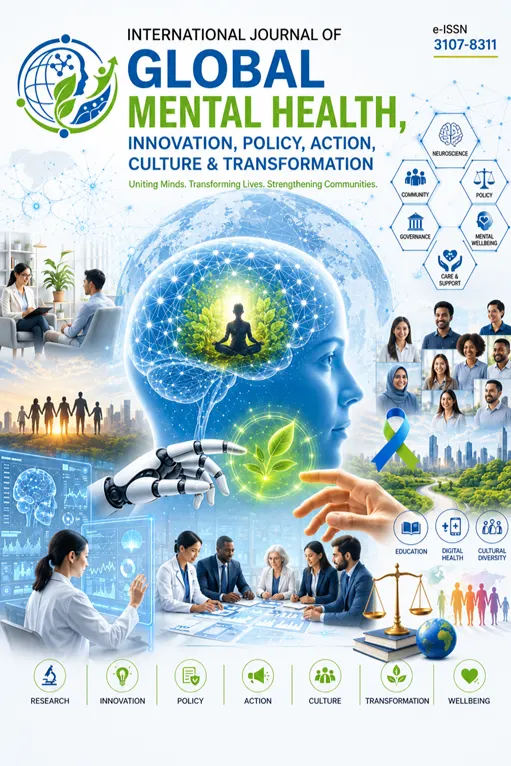
Volume 2 Issue 2 Cover

Issue Details:

Volume 2 Issue 2
Published:Apr 11, 2026

Editorial: April-June

Welcome to the 2026 issue of International Journal of Global Mental Health, Innovation, Policy, Action, Culture & Transformation. This issue showcases the remarkable breadth and depth of contemporary research across multiple disciplines. From cutting-edge applications of machine learning in climate science to the revolutionary potential of quantum computing in drug discovery, our featured articles demonstrate the power of interdisciplinary collaboration in addressing global challenges.

We are particularly excited to present research that bridges traditional academic boundaries, reflecting our journal's commitment to fostering innovation through cross-disciplinary dialogue. The integration of artificial intelligence with environmental science, the application of blockchain technology to supply chain management, and the convergence of urban planning with smart city technologies exemplify the transformative potential of collaborative research.

As we continue to navigate an era of rapid technological advancement and global challenges, the research presented in this issue offers both insights and solutions that will shape our future. We thank our authors, reviewers, and editorial board members for their continued dedication to advancing knowledge and promoting scientific excellence.

Dr. Aashna Narula
Editor in Chief
International Journal of Global Mental Health, Innovation, Policy, Action, Culture & Transformation

Articles in This Issue

Showing 5 of 5 articles
Research PaperID: impact-00001343Pages 1-11

Correlational study of Sociocultural Adaptation, Resilience and Self Compassion among Tibetan Youth in Exile in India

Dechen Chonzom, Soumya Simon

This study aimed to explore the relationships between sociocultural adaptation, self-compassion, and resilience among Tibetan youth living in exile. Due to the displacement from their homeland, it has created difficulties for the youth in exile in the aspects of social and cultural adaptations which includes cultural identity, language and unique psychological difficulties. In this study, it examined how the resources such as internal and external resources can affect their overall well-being and adjustment.

7,023 views
2,071 downloads

Contributors:

 Dechen Chonzom
,
 Soumya Simon
Research PaperID: impact-00001344Pages 1-19

The Influence of Relationship Status and Emotion Regulation on Self Esteem and Relationship Anxiety

Meghna Singh, Dr. Deepika Lohan, Jaswant Singh

This study examines the relationship between different relationship statuses such as being single, in a situational relationship, in a committed relationship, or married and a person’s ability to regulate their emotions, as well as their self-esteem and relationship anxiety. A total of 268 individuals between the ages of 18 and 60 participated by completing an online survey using three well-established psychological scales: the Difficulties in Emotion Regulation Scale–Short Form (DERS-SF), the Rosenberg Self-Esteem Scale (RSES), and the Experiences in Close Relationships–Short Form (ECR-S). To understand patterns and differences, the data were analyzed using one-way ANOVA, Tukey’s HSD post hoc test, and Pearson’s correlation. The results showed that individuals in stable, committed relationships and those who reported better emotional regulation tended to have higher self-esteem. However, relationship status and emotional regulation did not significantly predict relationship anxiety, pointing to the possibility that other factors like personal coping styles or emotional closeness may be more critical.

7,007 views
2,056 downloads

Contributors:

 Meghna Singh
,
 Dr. Deepika Lohan
,
 Jaswant Singh
Research PaperID: impact-00001356Pages 1-12

Dating Apps, Moral Disengagement, and Break Up Distress Among Indian Emerging Adults: A Comparative Study

Mahi Singh, Sharmili Chatterjee

Background: The rapid proliferation of dating applications has transformed romantic relationship initiation among Indian young adults, yet the psychological implications of this shift remain understudied. Objective: This study compared dating app users and non-users seeking romantic relationships on three psychological constructs: moral disengagement, self-concept clarity, and break-up distress. Method: Using a quantitative, non-experimental comparative design, 250 Indian young adults aged 18–26 years completed standardized measures of moral disengagement , self-concept clarity , and break-up distress . Independent samples t-tests were conducted using Jamovi. Results: Dating app users reported significantly higher moral disengagement than non-users, t(249) = –2.98, p = .003, d = 0.38. No significant differences were found in self-concept clarity (p = .513, d = 0.08) or break-up distress (p = .115, d = 0.20). Conclusion: Digital dating environments may heighten cognitive moral disengagement without fundamentally destabilizing identity or amplifying emotional distress after relationship dissolution. These findings have implications for clinical practice, digital literacy education, and platform design within the Indian sociocultural context.

7,140 views
2,141 downloads

Contributors:

 Mahi Singh
,
 Sharmili Chatterjee
Research PaperID: impact-00001516Pages 1-10

EXPLORING THE RELATIONSHIP BETWEEN ATTACHMENT STYLES, RELATIONSHIP SATISFACTION, AND SLEEP DISTURBANCES AMONG YOUNG ADULTS IN INDIA

Ateena Aleyamma Iype, Dr. Lokesh L

This study examined the relationships between attachment styles, relationship satisfaction, and sleep disturbances among 300 young adults (mean age = 21.7 years) in India, specifically testing whether relationship satisfaction mediates the attachment-sleep pathway. Participants in committed romantic relationships completed the Experiences in Close Relationships-Revised Short Form (ECR-R), Relationship Assessment Scale (RAS), and Pittsburgh Sleep Quality Index (PSQI). Correlation analyses revealed significant associations: attachment insecurity positively correlated with sleep disturbances (r = .530, p

7,152 views
2,218 downloads

Contributors:

 Ateena Aleyamma Iype
,
 Dr. Lokesh L
Research PaperID: impact-00001524Pages 1-16

Sustainable Happiness Through Spirituality-Based Holistic Practices: An In-Depth Study from Central India

Saumya Subramanian, Divya Kanchibhotla

Sustainable happiness is the ultimate aspiration behind all the pursuits in life. With an increase in stress and mental health disorders, the happiness index is dropping significantly. Primary objective: This study investigated the role of spirituality based yogic practices in improving happiness and life satisfaction. Scope: The study aims to identify feasible holistic solutions for achieving sustainable happiness in today’s fast-paced world. Methods: The study involved 459 participants from central India participating in the study. The study population was divided into two spirituality based yogic practices namely, Sudarshan Kriya Yoga (SKY) (N=252) and other yogic practices (N=207). Both the groups underwent a set of self-reported questionnaires at baseline, after 3 months and 6 months of practice. The parameters assessed included, subjective happiness and life-satisfaction using Oxford Happiness Scale, Subjective Happiness scale and Satisfaction with Life scale. Results: The results demonstrated a significant benefit of the yogic interventions in improving individual perception on subjective happiness and life satisfaction. The SKY group demonstrated a significant improvement in all three assessment parameters across the time points while the yoga group demonstrated a slight improvement at the 3 months’ time point and showed gradual improvement after 6 months’ practice. Implications: The findings of this study offer a pathway toward an economical and feasible approach to improve mental wellbeing providing sustainable happiness and life satisfaction among individuals. Additionally, it can also help policy makers to adopt holistic practices to increase the happiness quotient of India.

7,295 views
2,173 downloads

Contributors:

 Saumya Subramanian
,
 Divya Kanchibhotla
Whatsapp