
OJS vs ScholarJMS: Which Platform Is Better for a New Psychology or Mental Health Journal?
OJS vs ScholarJMS: Which Platform Is Better for a New Psychology or Mental Health Journal?
Introduction: Choosing the Right Platform for Mental Health Publishing
Launching a psychology or global mental health journal in 2026 requires more than academic intent. It requires a robust, scalable, and efficient publishing platform that can handle the complexity of modern research workflows.
Mental health journals today deal with:
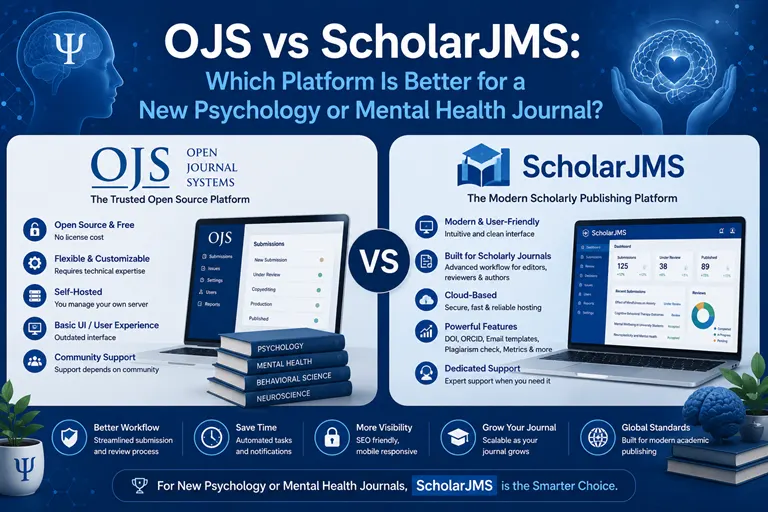
- Sensitive human-subject research
- Ethical approvals and documentation
- Multidisciplinary submissions
- International authors and reviewers
- Transparent and accountable peer review
Choosing the wrong platform can result in delays, inefficiencies, poor author experience, and long-term operational challenges.
Two of the most commonly considered options are:
- Open Journal Systems (OJS)
- ScholarJMS (modern journal management platform)
This article provides a detailed, practical comparison to help universities, research institutions, and journal founders make the right decision.
Understanding OJS: The Open-Source Publishing Standard
What is OJS?
Open Journal Systems (OJS) is an open-source journal management system widely used by academic institutions worldwide. It provides basic functionality for:
- Manuscript submission
- Editorial workflow
- Peer review management
- Article publishing
It is popular because it is free to install and supported by a global academic community.
Strengths of OJS
- No licensing cost
- Open-source flexibility
- Large user base
- Customisable with plugins
Limitations of OJS
Despite its popularity, OJS comes with several challenges:
- Requires technical setup and hosting
- Needs regular maintenance and updates
- Plugin compatibility issues
- Limited modern user experience
- Dependency on developers for customisation
For psychology and mental health journals, where workflow sensitivity and efficiency are critical, these limitations can become significant barriers.
Understanding ScholarJMS: A Modern Publishing Ecosystem
What is ScholarJMS?
ScholarJMS is a modern, integrated journal management system designed specifically for academic publishing. It combines:
- Journal website
- Manuscript submission system
- Editorial workflow management
- Article publishing structure
into a single unified platform.
Key strengths of ScholarJMS
- Fully managed system with minimal technical dependency
- Clean, modern user interface
- End-to-end workflow automation
- Built for scalability and growth
- Integrated publishing infrastructure
Why it suits mental health journals
Mental health publishing requires structured workflows, confidentiality, and clarity. ScholarJMS supports:
- Role-based access control
- Secure manuscript handling
- Efficient reviewer tracking
- Transparent editorial decisions
Core Comparison: OJS vs ScholarJMS
1. Setup and Technical Requirements
OJS requires:
- Server hosting
- Installation
- Technical configuration
- Ongoing maintenance
ScholarJMS offers:
- Ready-to-use platform
- Fully managed setup
- No server or coding requirements
For institutions without dedicated IT teams, ScholarJMS provides a significantly smoother start.
2. User Experience and Interface
OJS interface:
- Functional but outdated
- Complex navigation for new users
ScholarJMS interface:
- Clean and intuitive
- Designed for authors, editors, and reviewers
A better user experience leads to higher submission rates and smoother workflow.
3. Manuscript Submission Workflow
OJS:
- Multi-step submission process
- Can be confusing for new authors
ScholarJMS:
- Guided submission flow
- Simplified document upload and tracking
- Real-time status updates
This is particularly important for mental health researchers who may be submitting interdisciplinary or policy-based work.
4. Peer Review Management
OJS:
- Supports peer review but requires manual coordination
- Limited automation
ScholarJMS:
- Automated reviewer assignment
- Reminder systems
- Structured review tracking
When combined with Scholar9, journals can also enable transparent peer review ecosystems, enhancing trust and accountability.
Planning to upgrade your journal system?
We can help you with:
- ScholarJMS platform setup
- Complete editorial workflow configuration
- OJS migration and technical support
- Peer review system optimisation
5. Website and Publishing Integration
OJS:
- Website and workflow often feel separate
- Requires design customisation
ScholarJMS:
- Integrated journal website + submission system
- Professional design out of the box
This ensures consistency in branding and user experience.
6. Maintenance and Technical Dependency
OJS:
- Requires updates, backups, and troubleshooting
- Often needs developer support
ScholarJMS:
- Fully managed platform
- No technical maintenance required by the journal
This reduces long-term operational burden.
7. Scalability and Growth
OJS:
- Can scale but requires technical upgrades
ScholarJMS:
- Designed for growing journals
- Handles increasing submissions smoothly
For emerging journals like those in global mental health, scalability is critical.
The Role of OJSCloud in Supporting OJS Journals
OJS remains a strong option for institutions that prefer open-source systems.
With OJSCloud, journals can:
- Get managed OJS hosting
- Receive installation and setup support
- Ensure regular updates and maintenance
- Improve performance and security
This allows journals to use OJS without technical challenges.
DOI, Metadata, and Indexing Considerations
Regardless of platform, journals must ensure proper DOI integration.
Why DOI matters
- Permanent article identification
- Improved citation tracking
- Indexing readiness
Challenges
- Metadata formatting
- Crossref integration
- DOI management
With GetDOI, journals can:
- Set up Crossref DOI
- Manage metadata submission
- Integrate DOI workflows into their system
Need DOI support for your journal?
We can assist with:
- Crossref DOI registration
- Metadata setup and submission
- DOI workflow integration
- Indexing readiness preparation
Which Platform Should You Choose?
Choose OJS if:
- You have a strong technical team
- You prefer open-source flexibility
- You are comfortable managing hosting and maintenance
Choose ScholarJMS if:
- You want a ready-to-use, modern system
- You prefer minimal technical dependency
- You want faster setup and scalability
- You prioritise user experience and workflow efficiency
A Practical Recommendation for New Mental Health Journals
For new psychology and mental health journals, especially in emerging academic environments, the focus should be on:
- Editorial quality
- Research integrity
- Author experience
- Efficient workflow
Spending excessive time on technical management can distract from these priorities.
A modern, managed platform like ScholarJMS allows journal teams to focus on research and publishing, rather than infrastructure.
Frequently Asked Questions (FAQs)
Is OJS completely free?
Yes, OJS is open-source and free to use, but it requires hosting, setup, and maintenance, which may involve costs.
Is ScholarJMS suitable for new journals?
Yes, it is designed for both new and growing journals, offering easy setup and scalability.
Can I migrate from OJS to ScholarJMS?
Yes, migration is possible with proper technical support, ensuring no data loss.
Which platform is better for peer review management?
ScholarJMS offers more automation and ease of use, while OJS may require manual coordination.
Do both platforms support DOI integration?
Yes, but DOI setup requires external support such as Crossref integration, which can be facilitated through services like GetDOI.
Conclusion
Choosing between OJS and ScholarJMS is not just a technical decision. It is a strategic decision that will shape the efficiency, credibility, and growth of your journal.
OJS provides flexibility and open-source control, while ScholarJMS offers a modern, integrated, and managed publishing experience.
For psychology and global mental health journals aiming to build strong editorial systems, attract quality submissions, and scale efficiently, the right platform can make a significant difference.
If you are planning to start or upgrade your journal, expert guidance can help you avoid costly mistakes and ensure a smooth launch.
We can support you in selecting, setting up, and managing the right publishing platform for your journal.
WhatsApp: +91 82003 85143
Email: inquiry@ojscloud.com