
Why Mental Health and Psychology Journals Need a Modern Manuscript Submission and Peer-Review System
Why Mental Health and Psychology Journals Need a Modern Manuscript Submission and Peer-Review System
Introduction: The Growing Complexity of Mental Health Publishing
The field of mental health and psychology is evolving rapidly. Research today spans clinical psychology, community interventions, digital mental health, cross-cultural studies, public policy, and interdisciplinary social sciences. As the scope of research expands, so does the complexity of managing scholarly publications.
Journals in this domain are no longer dealing with simple manuscript submissions. They must handle:
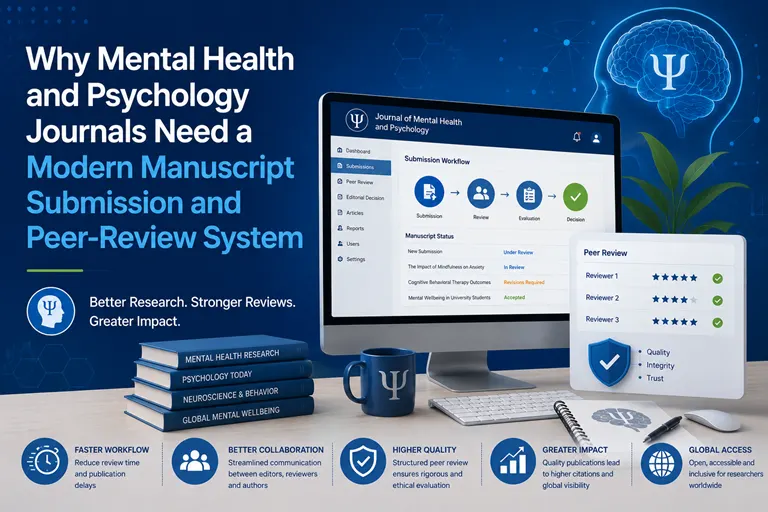
- Sensitive human-subject research
- Ethical approvals and compliance documentation
- Multidisciplinary reviewer selection
- International authors and contributors
- Transparent and accountable peer review processes
Despite these growing demands, many mental health and psychology journals still rely on outdated systems such as email-based submissions or poorly configured platforms. This creates inefficiencies, delays, and risks to research integrity.
A modern manuscript submission and peer-review system is no longer optional. It is essential.
The Limitations of Traditional Submission and Review Methods
Email-based manuscript handling
Many journals continue to accept submissions via email, which leads to:
- Difficulty tracking manuscript versions
- Miscommunication between editors and reviewers
- Lost or overlooked submissions
- Lack of audit trails
In mental health research, where ethical documentation and revisions are critical, such gaps can compromise both quality and compliance.
Fragmented editorial workflows
Without a structured system, editorial tasks are often managed manually using spreadsheets or separate tools. This results in:
- Delayed reviewer assignments
- Inconsistent decision-making timelines
- Poor coordination among editorial team members
Lack of transparency and accountability
Authors today expect clarity in the review process. Traditional systems often fail to provide:
- Status tracking
- Reviewer accountability
- Clear communication timelines
This affects author trust and journal reputation.
Why Mental Health Journals Require Specialised Workflow Systems
Mental health and psychology journals deal with unique challenges that demand robust systems.
Ethical sensitivity and compliance
Research in this field often involves:
- Human participants
- Vulnerable populations
- Confidential psychological data
A modern system must allow structured handling of:
- Ethics approvals
- Consent documentation
- Data confidentiality protocols
Multidisciplinary review requirements
Global mental health research may require reviewers from:
- Psychology and psychiatry
- Public health
- Sociology and anthropology
- Policy and governance
A system must support intelligent reviewer selection and tracking.
International collaboration
Authors and reviewers often come from different countries, time zones, and institutions. A digital platform ensures:
- Seamless communication
- Automated reminders
- Standardised workflows
Core Features of a Modern Manuscript Submission System
A high-quality system is not just a submission portal. It is a complete editorial ecosystem.
End-to-end manuscript tracking
From submission to publication, every stage must be tracked, including:
- Initial screening
- Peer review
- Revisions
- Final decision
- Publication
Automated workflow management
Automation helps reduce manual effort by:
- Assigning reviewers
- Sending reminders
- Managing deadlines
- Tracking revisions
Role-based access control
Different stakeholders require different access levels:
- Authors
- Editors
- Reviewers
- Administrators
A structured system ensures data security and workflow clarity.
Integrated communication system
Centralised communication avoids confusion and ensures that all interactions are documented.
Publication-ready output
The system should support structured article publishing, metadata management, and indexing readiness.
The Importance of Transparent and Accountable Peer Review
Peer review is the foundation of scholarly publishing. In mental health research, its importance is even greater.
Building trust in research
Transparent review processes help:
- Improve credibility
- Reduce bias
- Enhance research quality
Reviewer recognition and accountability
Modern systems can provide:
- Reviewer tracking
- Performance records
- Recognition mechanisms
Platforms like Scholar9 support transparent peer review ecosystems that strengthen research trust.
Need help modernising your journal workflow?
We can support you with:
- ScholarJMS journal management system setup
- Complete manuscript submission workflow
- Peer review automation and tracking
- OJS migration and technical upgrades
- Editorial process optimisation
Why ScholarJMS Is a Strong Solution for Modern Journals
Modern journals require more than just software. They need a system that understands academic publishing workflows.
Integrated journal ecosystem
ScholarJMS offers:
- Journal website + submission system in one platform
- Structured editorial workflow
- Reviewer management
- Automated communication
- Publication-ready article display
Designed for academic publishing
Unlike generic systems, ScholarJMS is built specifically for:
- Scholarly journals
- Editorial teams
- Research workflows
Scalability for growing journals
Emerging journals, like many in global mental health, need systems that can scale as submissions increase.
Transitioning from OJS or Legacy Systems
Open Journal Systems (OJS) is widely used, but many journals face challenges such as:
- Technical maintenance
- Hosting issues
- Plugin management
- User experience limitations
When to consider migration
- Increasing submission volume
- Workflow inefficiencies
- Technical dependency on developers
- Need for better user experience
With OJSCloud, journals can:
- Get managed OJS hosting
- Receive expert technical support
- Migrate to modern systems like ScholarJMS without data loss
The Role of DOI and Metadata in Workflow Systems
A modern system must integrate with DOI workflows.
Why DOI integration matters
- Ensures permanent article identification
- Improves citation tracking
- Supports indexing requirements
Challenges without integration
- Manual DOI assignment
- Metadata errors
- Delayed publication
With GetDOI, journals can streamline:
- Crossref DOI setup
- Metadata submission
- DOI workflow integration
Looking to integrate DOI and streamline publishing?
We can help you with:
- Crossref DOI setup and support
- Metadata and indexing readiness
- Workflow integration with your journal system
- Complete publishing infrastructure setup
Enhancing Author Experience and Submission Quality
A modern system significantly improves the author journey.
Simplified submission process
- Guided submission forms
- Clear instructions
- Document uploads with validation
Real-time tracking
Authors can monitor:
- Review status
- Editorial decisions
- Revision requirements
This transparency improves satisfaction and encourages repeat submissions.
Strengthening Journal Reputation and Indexing Readiness
Indexing agencies evaluate journals based on:
- Editorial quality
- Consistency
- Transparency
- Technical infrastructure
A modern system helps journals meet these standards by:
- Maintaining structured records
- Ensuring timely publication
- Supporting metadata accuracy
This is essential for indexing in DOAJ, Scopus, and other databases.
Frequently Asked Questions (FAQs)
What is a manuscript submission system?
It is an online platform that manages the entire process of submitting, reviewing, and publishing academic manuscripts.
Why is email-based submission not recommended?
It lacks tracking, transparency, and efficiency, leading to delays and errors in the editorial process.
Can OJS handle modern journal needs?
OJS can support many workflows, but it often requires technical expertise and maintenance. Managed solutions or modern platforms may offer better usability.
How does peer review automation help journals?
It speeds up reviewer assignment, ensures timely reminders, and improves overall workflow efficiency.
Is DOI integration necessary for journals?
Yes, DOI is essential for credibility, citation tracking, and indexing readiness.
Conclusion
The future of mental health and psychology publishing depends on efficiency, transparency, and trust. As research becomes more interdisciplinary and globally distributed, journals must adopt systems that can handle this complexity.
A modern manuscript submission and peer-review system is not just a technical upgrade. It is a strategic investment in:
- Research quality
- Editorial efficiency
- Author satisfaction
- Journal credibility
For journals aiming to grow, attract quality submissions, and achieve indexing, upgrading to a modern system is a critical step.
If your journal is still relying on outdated workflows, now is the time to transform.
We can help you modernise your journal with the right technology and support.
WhatsApp: +91 82003 85143
Email: inquiry@ojscloud.com