
Mental Health Policy Implementation: Bridging the Gap Between Research, Reform, and Community Action
Mental Health Policy Implementation: Bridging the Gap Between Research, Reform, and Community Action
Introduction: From Policy Design to Real-World Impact
Across the globe, mental health has gained unprecedented attention in national and international policy agendas. Governments, global health organisations, and academic institutions have developed comprehensive frameworks to address mental health challenges through structured policies and reforms.
However, a persistent gap remains between policy design and real-world impact. While many countries have progressive mental health policies on paper, their implementation often falls short due to systemic, social, and operational challenges.
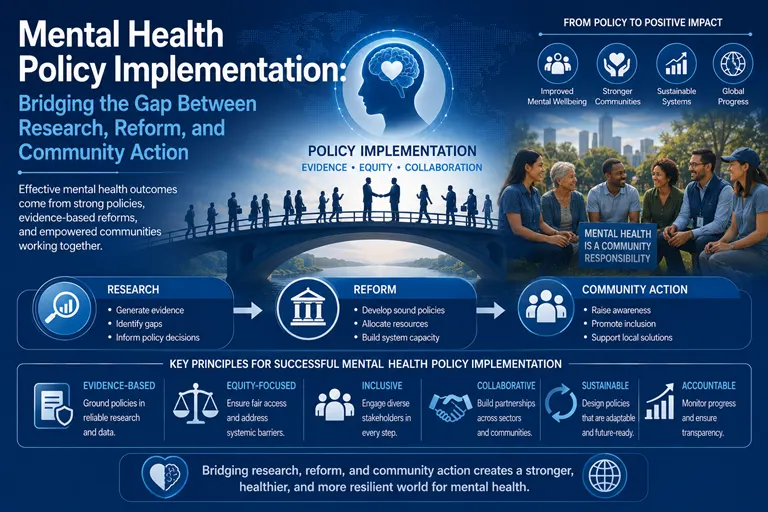
In 2026, the focus of global mental health research is increasingly shifting toward implementation science, which examines how policies can be effectively translated into practice.
The International Journal of Global Mental Health, Innovation, Policy, Action, Culture & Transformation (IMPACT) highlights the importance of bridging research, reform, and community action to ensure that mental health policies lead to meaningful and sustainable change.
Understanding Mental Health Policy Implementation
What is policy implementation?
Policy implementation refers to the process of translating policy decisions into actionable programmes, services, and outcomes.
It involves:
- Operational planning
- Resource allocation
- Workforce development
- Service delivery
- Monitoring and evaluation
Why implementation matters
A well-designed policy has little value if it is not effectively implemented. Implementation determines whether:
- Services reach those in need
- Resources are used efficiently
- Intended outcomes are achieved
The Gap Between Research, Policy, and Practice
Disconnect between evidence and policy
Research often produces valuable insights, but these do not always influence policy decisions. Reasons include:
- Lack of communication between researchers and policymakers
- Limited accessibility of research findings
- Political and economic constraints
Policy-practice divide
Even when policies are informed by research, challenges arise during execution, such as:
- Inadequate infrastructure
- Workforce shortages
- Weak governance systems
Limited community engagement
Policies designed without community input may fail to address real needs, leading to low adoption and impact.
Key Barriers to Effective Implementation
Resource constraints
Many countries, particularly in the Global South, face:
- Limited funding for mental health
- Shortage of trained professionals
- Inadequate facilities and infrastructure
Workforce challenges
Mental health systems often struggle with:
- Lack of specialised professionals
- Unequal distribution of services
- Burnout and high workload
Governance and coordination issues
Effective implementation requires coordination across:
- Health departments
- Social services
- Education systems
- Community organisations
Lack of coordination can lead to fragmented services.
The Role of Implementation Science in Mental Health
What is implementation science?
Implementation science studies methods to promote the systematic uptake of research findings into practice.
Key focus areas
- Identifying barriers and facilitators
- Designing context-specific strategies
- Evaluating real-world outcomes
- Scaling successful interventions
Importance in global mental health
Implementation science helps ensure that policies are:
- Practical
- Scalable
- Sustainable
Community-Centred Approaches to Policy Implementation
Engaging local communities
Community involvement is essential for:
- Identifying local needs
- Building trust
- Ensuring cultural relevance
Task-sharing and decentralised care
In many regions, mental health services are delivered through:
- Community health workers
- Peer support networks
- Local organisations
This approach increases accessibility and reduces reliance on specialists.
Strengthening community resilience
Policies should promote:
- Social support systems
- Community awareness
- Preventive care
Integrating Cultural Context into Policy Implementation
Cultural sensitivity in programme design
Policies must consider:
- Local beliefs about mental health
- Language and communication styles
- Social norms and practices
Avoiding one-size-fits-all solutions
Standardised interventions may not work across diverse contexts. Adaptation is essential for effectiveness.
The Role of Technology in Policy Implementation
Digital tools for service delivery
Technology can support implementation through:
- Tele-mental health services
- Mobile health applications
- Digital training platforms
Data-driven decision-making
Digital systems enable:
- Real-time monitoring
- Outcome tracking
- Evidence-based adjustments
Challenges
- Digital divide
- Data privacy concerns
- Limited infrastructure in some regions
Monitoring, Evaluation, and Accountability
Importance of evaluation
Continuous evaluation ensures that policies are:
- Effective
- Efficient
- Aligned with goals
Key indicators
- Service coverage
- Quality of care
- Patient outcomes
- Equity in access
Accountability mechanisms
Transparent reporting and stakeholder engagement are essential for maintaining accountability.
The Role of Academic Journals in Advancing Policy Implementation
Academic journals contribute by:
- Publishing implementation research
- Sharing best practices
- Highlighting successful models
- Encouraging interdisciplinary dialogue
The International Journal of Global Mental Health, Innovation, Policy, Action, Culture & Transformation (IMPACT) provides a platform for research that connects policy with real-world action.
A Note for Institutions and Policy-Focused Journals
Institutions working in mental health policy and implementation are increasingly establishing specialised journals to publish research in this domain.
To build a credible journal, it is important to ensure:
- Structured manuscript submission systems
- Transparent peer review workflows
- ISSN and DOI readiness
- Scalable publishing infrastructure
Modern platforms like ScholarJMS, supported by OJSCloud and GetDOI, can help institutions create professional and sustainable journal ecosystems.
Frequently Asked Questions (FAQs)
What is mental health policy implementation?
It is the process of translating mental health policies into actionable programmes and services.
Why do mental health policies often fail?
Common reasons include resource constraints, lack of trained professionals, weak governance, and limited community engagement.
What is implementation science?
It is a field of research focused on how to effectively apply research findings in real-world settings.
How can communities support policy implementation?
Communities help identify needs, build trust, and ensure that interventions are culturally relevant and accessible.
What role does technology play in implementation?
Technology supports service delivery, monitoring, and data-driven decision-making but must be used carefully to address ethical and accessibility concerns.
Conclusion
Mental health policy implementation is the critical link between research, reform, and real-world impact. Without effective implementation, even the most well-designed policies cannot achieve their intended outcomes.
By addressing barriers, engaging communities, integrating cultural context, and leveraging technology, policymakers and researchers can bridge the gap between theory and practice.
The International Journal of Global Mental Health, Innovation, Policy, Action, Culture & Transformation (IMPACT) remains committed to advancing research that transforms policy into meaningful action.
Researchers, practitioners, and policymakers are encouraged to contribute to this important field and help shape more effective and equitable mental health systems.