
How to Get ISSN and Crossref DOI Support for a New Mental Health or Psychology Journal
How to Get ISSN and Crossref DOI Support for a New Mental Health or Psychology Journal
Introduction: Why ISSN and DOI Are Critical for Journal Credibility
Starting a mental health or psychology journal is a meaningful academic initiative. However, credibility in scholarly publishing is not built by content alone. It is established through formal recognition, structured publishing identity, and global discoverability.
Two of the most essential components of this foundation are:
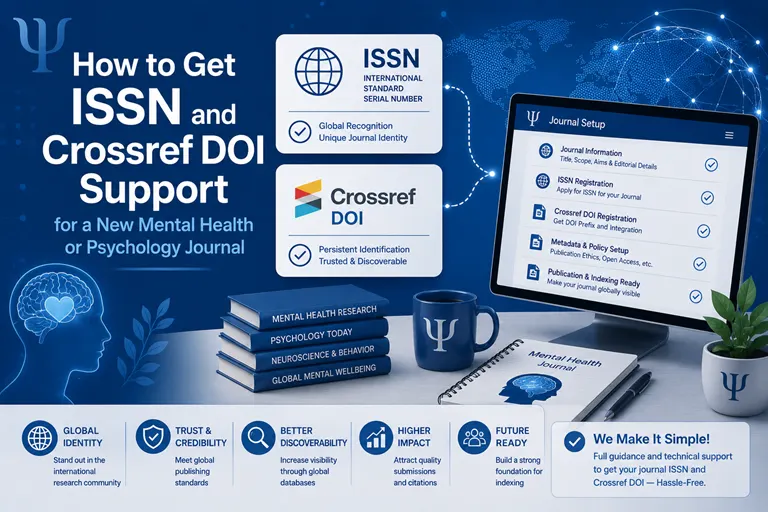
- ISSN (International Standard Serial Number)
- DOI (Digital Object Identifier via Crossref)
Without these, a journal may struggle to gain trust, attract quality submissions, or achieve indexing in major databases.
For emerging journals, especially in global mental health, where interdisciplinary and culturally grounded research is growing rapidly, proper ISSN and DOI setup is not optional. It is a strategic necessity.
This guide by the International Journal of Global Mental Health, Innovation, Policy, Action, Culture & Transformation (IMPACT) provides a clear, step-by-step approach to obtaining ISSN and Crossref DOI support.
Understanding ISSN: The Foundation of Journal Identity
What is an ISSN?
ISSN is an 8-digit unique identifier assigned to serial publications such as academic journals. It distinguishes your journal from all others globally.
For online journals, an e-ISSN is issued.
Why ISSN is essential
- Establishes your journal as a recognised serial publication
- Required for indexing in databases like DOAJ and Scopus
- Enhances institutional credibility
- Supports library and cataloguing systems
Without ISSN, your journal lacks formal publishing identity.
When Should You Apply for ISSN?
Timing is critical in ISSN application.
Ideal stage for application
You should apply for ISSN when:
- Your journal website is fully developed
- Core pages are available (About, Editorial Board, Author Guidelines)
- Publication policies are clearly defined
- Submission system is functional
Applying too early is one of the most common mistakes.
Common reasons for ISSN rejection
- Incomplete or underdeveloped website
- Missing editorial information
- Lack of clear aims and scope
- Poor presentation or structure
- No visible publishing plan
This is why many journals benefit from ISSN consulting support before applying.
Preparing Your Journal for ISSN Approval
Before submitting your application, ensure your journal meets key readiness criteria.
Essential website components
- Journal homepage with clear identity
- About the Journal section
- Aims & Scope
- Editorial Board details
- Author Guidelines
- Publication ethics and policies
- Contact information
Technical and structural readiness
- Functional journal website
- Consistent design and navigation
- Clear submission process
Platforms like ScholarJMS help journals meet these requirements efficiently by providing a structured publishing environment.
How to Apply for ISSN (Step-by-Step)
Step 1: Identify your national ISSN centre
ISSN is issued by national agencies. You must apply through your country’s ISSN centre.
Step 2: Prepare required documents
- Journal title
- Publisher details
- Website URL
- Editorial board information
- Sample content or issue plan
Step 3: Submit application
Applications are usually submitted online via the ISSN portal of your country.
Step 4: Wait for review and approval
The review process may take a few weeks. If your journal meets the criteria, you will receive your ISSN.
The Role of OJSCloud in ISSN Consulting
Many journal applications are delayed or rejected due to avoidable issues.
With OJSCloud, journals can receive:
- Pre-application website review
- ISSN readiness checklist
- Documentation support
- Guidance on improving approval chances
This significantly increases the likelihood of successful ISSN registration.
Need help getting ISSN for your journal?
We can assist you with:
- ISSN consulting and application support
- Journal website readiness review
- ScholarJMS journal setup
- OJS hosting and migration
Understanding Crossref DOI: The Backbone of Article Identification
What is a DOI?
A DOI (Digital Object Identifier) is a permanent, unique link assigned to each published article.
It ensures that even if your website changes, the article remains accessible.
Why DOI is essential
- Enables global citation and referencing
- Improves research visibility
- Required for indexing and credibility
- Supports metadata and linking systems
For mental health research, where long-term accessibility is critical, DOI is indispensable.
What is Crossref and Why It Matters
Crossref is a leading DOI registration agency for scholarly publications.
Role of Crossref
- Assigns DOI prefixes to publishers
- Maintains metadata records
- Enables citation linking
- Supports academic discovery systems
Without Crossref integration, DOI cannot function effectively.
Challenges in Setting Up Crossref DOI
Many journals struggle with DOI setup due to:
- Complex membership requirements
- Metadata formatting standards
- Technical integration challenges
- Ongoing maintenance requirements
Improper setup can lead to:
- Broken DOI links
- Rejected metadata submissions
- Delays in publication
How GetDOI Simplifies DOI Setup
With GetDOI, journals can streamline the entire DOI process.
Services include
- Crossref DOI setup and registration
- Prefix allocation guidance
- Metadata preparation
- DOI assignment workflow
- Ongoing support and troubleshooting
This ensures your journal meets international publishing standards.
Planning Crossref DOI for your journal?
We can help you with:
- DOI registration and setup
- Metadata formatting and submission
- Crossref integration
- Workflow optimisation
Integrating ISSN and DOI into Your Publishing Workflow
ISSN and DOI are not standalone elements. They must be integrated into your journal system.
Workflow integration steps
- Assign ISSN to your journal website
- Set up DOI prefix via Crossref
- Assign DOI to each article
- Submit metadata for indexing
- Maintain accurate records
A system like ScholarJMS supports this integration seamlessly.
Common Mistakes to Avoid
- Applying for ISSN before website readiness
- Using inconsistent journal titles
- Ignoring metadata quality
- Delaying DOI setup until after publication
- Managing DOI manually without structured workflow
Avoiding these mistakes saves time and protects your journal’s credibility.
Frequently Asked Questions (FAQs)
Is ISSN mandatory for a journal?
Yes, it is essential for recognition, indexing, and credibility.
Can I publish articles without DOI?
Technically yes, but it is strongly discouraged as it limits visibility and citation tracking.
How long does ISSN approval take?
Usually 2 to 4 weeks, depending on the national centre and application quality.
Do I need Crossref membership for DOI?
Yes, DOI registration requires Crossref membership or sponsorship support.
Can I get help with ISSN and DOI setup?
Yes, professional services like OJSCloud and GetDOI provide complete support.
Conclusion
ISSN and Crossref DOI are the backbone of modern academic publishing. For mental health and psychology journals, they are essential for:
- Establishing credibility
- Ensuring discoverability
- Supporting indexing
- Enhancing research impact
A well-prepared journal with proper ISSN and DOI integration is far more likely to succeed in today’s competitive academic environment.
If you are planning to launch or formalise your journal, getting expert guidance can save time, reduce errors, and improve outcomes.
We are here to support your journey from journal idea to global recognition.
WhatsApp: +91 82003 85143
Email: inquiry@ojscloud.com