
Indigenous and Global South Perspectives in Mental Health Research: Moving Beyond One-Size-Fits-All Models
Indigenous and Global South Perspectives in Mental Health Research: Moving Beyond One-Size-Fits-All Models
Introduction: Rethinking Global Mental Health Paradigms
Mental health research has historically been shaped by frameworks developed in Western, high-income countries. While these frameworks have contributed significantly to the understanding and treatment of mental disorders, they often fail to capture the lived realities, cultural contexts, and social determinants of mental health in diverse global populations.
As global mental health emerges as a priority across nations, there is growing recognition that one-size-fits-all models are not only insufficient but can also be counterproductive when applied to culturally diverse societies. Indigenous knowledge systems and Global South perspectives offer critical insights into community-based healing, culturally embedded wellbeing, and alternative conceptualisations of mental health.
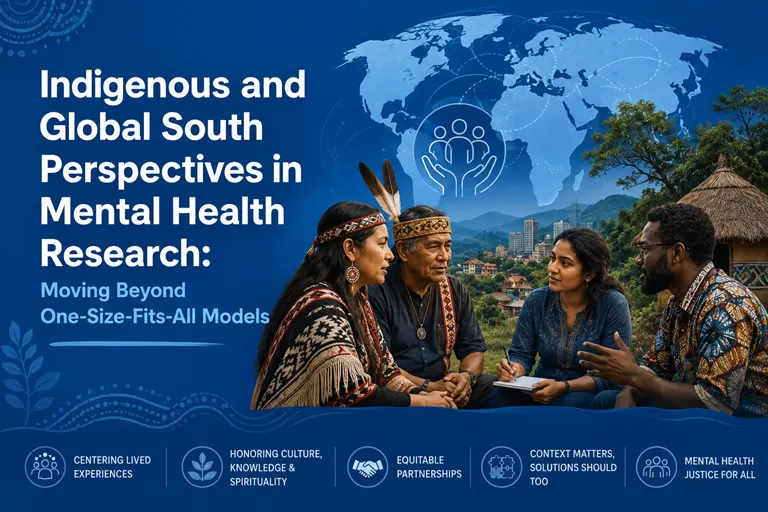
The International Journal of Global Mental Health, Innovation, Policy, Action, Culture & Transformation (IMPACT) is committed to advancing research that challenges dominant paradigms and promotes inclusive, culturally grounded mental health scholarship.
Understanding the Limitations of Universal Mental Health Models
Global mental health initiatives have often relied on standardised diagnostic frameworks, treatment protocols, and research methodologies derived from Western psychiatry and psychology.
Cultural mismatch in diagnosis and treatment
Mental health conditions are not experienced or expressed uniformly across cultures. Symptoms that are categorised as clinical disorders in one context may be understood differently in another. For example:
- Emotional distress may be expressed through physical symptoms in some cultures
- Spiritual experiences may be misclassified as psychiatric conditions
- Social suffering may be individualised rather than understood collectively
These mismatches can lead to misdiagnosis, ineffective treatment, and reduced trust in mental healthcare systems.
Over-medicalisation of mental health
Western models often prioritise clinical and pharmacological interventions, sometimes overlooking:
- Community support systems
- Traditional healing practices
- Cultural rituals and spiritual frameworks
- Social and economic determinants of wellbeing
This narrow focus can marginalise non-clinical approaches that are central to mental health in many Global South communities.
Defining Indigenous and Global South Perspectives
To move beyond universalised models, it is essential to understand what Indigenous and Global South perspectives represent in mental health research.
Indigenous perspectives
Indigenous mental health frameworks are rooted in:
- Holistic understandings of health that integrate mind, body, spirit, and environment
- Community-centred approaches rather than individualised care
- Intergenerational knowledge and traditional healing practices
- Deep connections to land, identity, and cultural continuity
These perspectives emphasise balance, harmony, and collective wellbeing rather than symptom reduction alone.
Global South perspectives
The Global South encompasses regions in Asia, Africa, Latin America, and parts of the Middle East that share common challenges related to:
- Resource constraints
- Colonial histories
- Social inequalities
- Diverse cultural and linguistic contexts
Mental health research in these regions often focuses on:
- Accessibility and affordability of care
- Community-based interventions
- Task-sharing and non-specialist delivery models
- Policy implementation in low-resource settings
- Integration of local knowledge systems
Why Cultural Context Matters in Mental Health Research
Mental health does not exist in isolation. It is shaped by culture, history, environment, and social structures.
Language and meaning
The language used to describe mental health experiences varies widely across cultures. Concepts such as depression, anxiety, or trauma may not have direct equivalents in many languages. Instead, emotional experiences may be expressed through culturally specific idioms.
Understanding these linguistic nuances is essential for accurate assessment and meaningful intervention.
Social determinants of mental health
In many Global South contexts, mental health is closely linked to:
- Poverty and economic instability
- Migration and displacement
- Conflict and political unrest
- Gender inequality
- Access to education and healthcare
Research that ignores these determinants risks oversimplifying complex mental health challenges.
Community and collective identity
Unlike individualistic frameworks, many cultures emphasise collective identity and social relationships. Mental wellbeing is often understood in terms of:
- Family cohesion
- Community belonging
- Social harmony
Interventions that focus solely on individual therapy may not align with these cultural realities.
Decolonising Mental Health Research
Decolonising mental health research involves critically examining how knowledge is produced, validated, and applied.
Challenging epistemic dominance
Western frameworks have historically dominated academic research, often sidelining Indigenous knowledge systems. Decolonisation requires:
- Recognising multiple ways of knowing
- Valuing oral traditions and lived experiences
- Including local researchers and communities in knowledge production
Ethical research practices
Research in Indigenous and Global South communities must prioritise:
- Informed consent and cultural sensitivity
- Community participation and co-creation
- Respect for local traditions and intellectual property
- Long-term benefits for the community
Reframing research priorities
Instead of imposing external research agendas, scholars should focus on:
- Locally relevant mental health challenges
- Community-defined outcomes
- Sustainable and scalable interventions
Community-Based and Culturally Responsive Interventions
One of the most significant contributions of Indigenous and Global South perspectives is the emphasis on community-based care.
Task-sharing and non-specialist care
In many low-resource settings, mental health services are delivered by:
- Community health workers
- Teachers and educators
- Peer support groups
- Non-governmental organisations
This approach increases accessibility and reduces the burden on limited specialist resources.
Integration of traditional healing systems
Traditional healers, spiritual leaders, and cultural practitioners play a vital role in mental health care in many communities. Integrating these systems with formal healthcare can:
- Enhance cultural acceptance
- Improve treatment adherence
- Build trust between communities and healthcare providers
Preventive and promotive approaches
Rather than focusing solely on treatment, many Global South models emphasise:
- Early intervention
- Community resilience
- Social support systems
- Mental health education and awareness
The Role of Policy and Systems in Advancing Equity
Policy plays a critical role in shaping mental health systems and ensuring equitable access to care.
Bridging research and implementation
Many countries have progressive mental health policies, but implementation remains a challenge. Research must address:
- Gaps between policy and practice
- Resource allocation and workforce development
- Monitoring and evaluation of programmes
Inclusive policy design
Policies should be designed with input from:
- Indigenous communities
- Local stakeholders
- Mental health service users
This ensures that policies are contextually relevant and socially inclusive.
Innovation and Technology in Global Mental Health
Digital innovation offers new opportunities to expand mental health services in underserved regions.
Tele-mental health and mobile interventions
Digital platforms can provide:
- Remote counselling and therapy
- Mental health education
- Screening and self-help tools
These solutions are particularly valuable in rural and remote areas.
Ethical considerations
While technology can improve access, it also raises concerns related to:
- Data privacy and security
- Digital divide and accessibility
- Cultural appropriateness of digital tools
Innovation must be guided by ethical principles and local context.
The Way Forward: Towards Inclusive and Transformative Mental Health Research
The future of global mental health lies in embracing diversity, equity, and cultural relevance.
Building collaborative research ecosystems
Strong partnerships between:
- Academic institutions
- Community organisations
- Policymakers
- International agencies
are essential for advancing inclusive research.
Strengthening local research capacity
Investing in local researchers and institutions in the Global South can:
- Improve contextual understanding
- Enhance research quality
- Promote sustainable knowledge production
Redefining success in mental health
Success should not be measured solely by clinical outcomes but also by:
- Improved quality of life
- Social inclusion
- Community wellbeing
- Cultural continuity
Frequently Asked Questions (FAQs)
What is meant by Indigenous mental health perspectives?
Indigenous mental health perspectives refer to culturally grounded approaches that integrate spiritual, social, environmental, and community dimensions of wellbeing, often rooted in traditional knowledge systems.
Why are Global South perspectives important in mental health research?
They provide insights into mental health challenges and solutions in diverse, resource-constrained, and culturally complex settings, helping to develop more inclusive and equitable models of care.
What does decolonising mental health research involve?
It involves challenging dominant Western frameworks, valuing local knowledge systems, and ensuring that research is conducted ethically and collaboratively with communities.
How can mental health interventions be made culturally responsive?
By incorporating local beliefs, languages, traditions, and community structures into the design and delivery of mental health services.
What role does policy play in global mental health?
Policy shapes access, funding, and implementation of mental health services, making it essential for achieving equitable and effective care systems.
Conclusion
Indigenous and Global South perspectives are not peripheral to global mental health research; they are essential to its transformation. Moving beyond one-size-fits-all models requires a fundamental shift in how mental health is understood, studied, and addressed.
By embracing culturally responsive frameworks, community-based approaches, and inclusive research practices, the global mental health community can develop solutions that are not only effective but also equitable and sustainable.
The International Journal of Global Mental Health, Innovation, Policy, Action, Culture & Transformation (IMPACT) continues to provide a platform for such transformative scholarship, encouraging researchers, practitioners, and policymakers to contribute to a more inclusive and globally relevant mental health discourse.