
Global Mental Health Research Trends in 2026: Innovation, Policy, Culture, Equity, and Community Action
Global Mental Health Research Trends in 2026: Innovation, Policy, Culture, Equity, and Community Action
Introduction: A Transformative Era in Global Mental Health
Global mental health is undergoing a profound transformation. Over the past decade, mental health has shifted from being a marginal topic in public health to a central pillar of global development, policy discourse, and interdisciplinary research.
In 2026, the field is characterised by:
- Increasing recognition of mental health as a human rights issue
- Integration of mental health into public policy frameworks
- Rapid technological innovation
- Growing emphasis on cultural relevance and community-driven care
- Expanding research contributions from the Global South
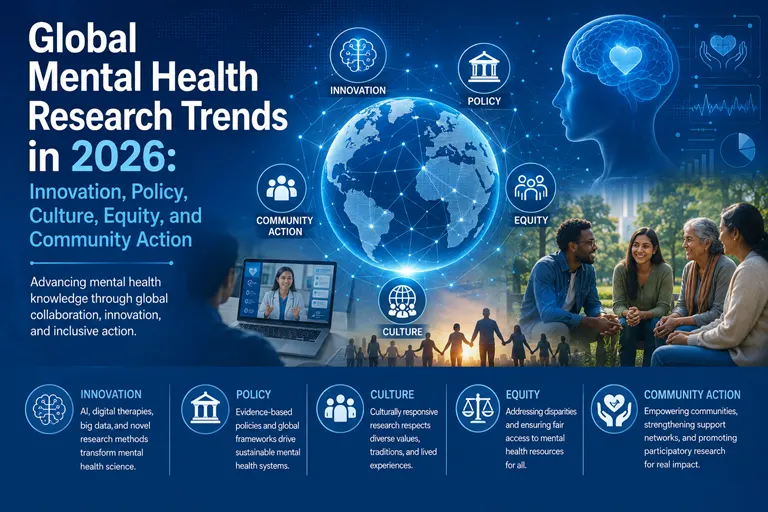
The International Journal of Global Mental Health, Innovation, Policy, Action, Culture & Transformation (IMPACT) is positioned at the intersection of these developments, providing a platform for research that bridges science, society, and real-world transformation.
This article explores the key research trends shaping global mental health in 2026 and beyond.
The Rise of Digital and AI-Driven Mental Health Innovation
Expansion of tele-mental health services
Tele-mental health has moved from a pandemic-driven necessity to a permanent component of mental healthcare systems. Researchers are exploring:
- Effectiveness of remote therapy
- Accessibility in rural and underserved regions
- Integration with primary healthcare systems
Artificial intelligence in mental health
AI is increasingly being used for:
- Early detection of mental health conditions
- Personalised treatment recommendations
- Chat-based mental health support systems
However, research is also focusing on ethical challenges such as:
- Algorithmic bias
- Data privacy
- Clinical accountability
Digital therapeutics and mobile interventions
Mobile apps and digital platforms are being evaluated for:
- Self-help and psychoeducation
- Behavioural interventions
- Continuous mental health monitoring
The challenge remains to ensure that these tools are evidence-based, culturally appropriate, and accessible.
Policy-Driven Mental Health Research and Implementation
Integration of mental health into national policies
Countries are increasingly incorporating mental health into:
- Universal health coverage frameworks
- National health missions
- Social welfare programmes
Research is focusing on how these policies are designed, funded, and implemented.
Bridging the gap between policy and practice
A major research priority in 2026 is understanding why well-designed policies often fail in real-world implementation.
Key areas of investigation include:
- Resource allocation
- Workforce shortages
- Governance and accountability
- Monitoring and evaluation mechanisms
Global mental health governance
International organisations and collaborations are shaping global agendas. Research is examining:
- Cross-country policy learning
- Global funding structures
- Equity in resource distribution
Cultural and Contextual Approaches to Mental Health
Moving beyond Western-centric models
There is increasing recognition that mental health frameworks developed in Western contexts cannot be universally applied.
Research is exploring:
- Cultural expressions of distress
- Indigenous healing practices
- Local conceptualisations of wellbeing
Language, identity, and mental health
Language plays a critical role in how mental health is understood and communicated. Studies are focusing on:
- Cultural idioms of distress
- Translation challenges in diagnosis
- Impact of language on treatment outcomes
Integrating traditional and modern systems
Researchers are examining how traditional healing systems can be integrated with formal healthcare to create:
- Culturally acceptable interventions
- Improved treatment adherence
- Holistic care models
Mental Health Equity and Social Determinants
Addressing structural inequalities
Mental health outcomes are deeply influenced by social and economic factors such as:
- Poverty
- Education
- Employment
- Housing
- Access to healthcare
Research is increasingly focused on addressing these structural determinants.
Vulnerable and marginalised populations
Special attention is being given to:
- Refugees and migrants
- Indigenous communities
- Women and gender minorities
- Children and adolescents
- People in conflict zones
Equity-focused research aims to reduce disparities in access and outcomes.
Community-Based Mental Health and Grassroots Action
Task-sharing and non-specialist care models
In many regions, mental health services are delivered by:
- Community health workers
- Peer supporters
- Local organisations
Research shows that these models can be effective in low-resource settings.
Community resilience and collective wellbeing
Mental health is increasingly understood as a collective phenomenon. Studies are exploring:
- Social support networks
- Community resilience frameworks
- Local coping strategies
Participatory and action-based research
Researchers are adopting participatory methods that involve communities in:
- Problem identification
- Intervention design
- Evaluation
This approach ensures that research is relevant and impactful.
Interdisciplinary and Multisectoral Research Approaches
Collaboration across disciplines
Global mental health research now involves:
- Psychology and psychiatry
- Public health
- Sociology and anthropology
- Education and policy studies
- Technology and data science
Linking research with real-world outcomes
There is a growing emphasis on research that leads to:
- Policy change
- Programme development
- Community impact
This aligns with the journal’s focus on innovation, policy, action, culture, and transformation.
Ethics, Research Integrity, and Responsible Innovation
Ethical challenges in global mental health
Research in diverse contexts raises questions about:
- Informed consent
- Cultural sensitivity
- Data protection
- Power dynamics
Responsible use of technology
As digital tools expand, researchers must ensure:
- Ethical AI deployment
- Protection of sensitive mental health data
- Inclusivity in technological design
The Role of Emerging Journals in Shaping the Field
Emerging journals like IMPACT play a crucial role in:
- Amplifying underrepresented voices
- Promoting interdisciplinary research
- Encouraging policy-relevant scholarship
- Supporting Global South contributions
By providing a platform for innovative and culturally grounded research, such journals contribute to the evolution of global mental health.
A Note for Institutions and Researchers Building New Journals
As global mental health research expands, many institutions are considering launching their own journals in psychology and mental health.
Building a credible journal requires:
- A structured manuscript submission system
- Efficient peer review workflow
- ISSN and DOI readiness
- Professional publishing infrastructure
Platforms like ScholarJMS, supported by OJSCloud and GetDOI, can help institutions establish strong, scalable journal systems aligned with international standards.
Frequently Asked Questions (FAQs)
What are the key global mental health research trends in 2026?
Major trends include digital innovation, policy integration, cultural approaches, equity-focused research, and community-based interventions.
Why is cultural context important in mental health research?
Cultural context shapes how mental health is experienced, expressed, and treated, making it essential for effective interventions.
What is community-based mental health care?
It refers to mental health services delivered within communities, often by non-specialists, focusing on accessibility and local relevance.
How is technology impacting mental health research?
Technology enables remote care, early detection, and data-driven interventions but also raises ethical and accessibility challenges.
Can institutions start their own mental health journals?
Yes, with the right infrastructure, editorial team, and publishing systems, institutions can successfully launch and manage academic journals.
Conclusion
Global mental health research in 2026 is defined by its diversity, inclusivity, and commitment to real-world impact. The field is moving beyond narrow clinical frameworks toward holistic, culturally grounded, and community-driven approaches.
Innovation, policy integration, equity, and interdisciplinary collaboration are shaping a new era of mental health research that is more responsive to global needs.
The International Journal of Global Mental Health, Innovation, Policy, Action, Culture & Transformation (IMPACT) remains dedicated to advancing this transformation by publishing research that bridges knowledge and action.
Researchers, practitioners, and policymakers are invited to contribute to this evolving discourse and help shape the future of global mental health.