
Culturally Responsive Mental Healthcare: Why Global Mental Health Interventions Must Adapt to Local Contexts
Culturally Responsive Mental Healthcare: Why Global Mental Health Interventions Must Adapt to Local Contexts
Introduction: Moving Beyond Universal Mental Health Models
Mental health has increasingly become a global priority, with governments, institutions, and international organisations investing in research and intervention strategies across diverse populations. However, a critical challenge remains: many mental health interventions are designed based on Western frameworks and are applied universally without sufficient adaptation to local cultural contexts.
In 2026, there is growing recognition that culturally responsive mental healthcare is not optional but essential for achieving meaningful and sustainable outcomes. Mental health is deeply shaped by cultural beliefs, social structures, language, and lived experiences. Ignoring these factors can lead to ineffective interventions, reduced engagement, and even harm.
The International Journal of Global Mental Health, Innovation, Policy, Action, Culture & Transformation (IMPACT) emphasises research that bridges cultural understanding with practical mental health solutions, ensuring that interventions are relevant, inclusive, and transformative.
Understanding Cultural Context in Mental Health
What is cultural context?
Cultural context refers to the shared values, beliefs, practices, and social norms that shape how individuals and communities understand and respond to mental health.
This includes:
- Beliefs about the causes of mental illness
- Attitudes toward treatment and care
- Social roles and expectations
- Religious and spiritual frameworks
Cultural variations in mental health expression
Mental health symptoms are not expressed uniformly across cultures. For example:
- Emotional distress may be expressed as physical symptoms in some cultures
- Concepts like depression or anxiety may not have direct linguistic equivalents
- Spiritual or religious experiences may be interpreted differently
Understanding these variations is essential for accurate diagnosis and effective treatment.
The Limitations of One-Size-Fits-All Interventions
Misalignment with local realities
Standardised interventions often fail because they do not align with:
- Local belief systems
- Community structures
- Available resources
Reduced engagement and trust
When interventions do not reflect cultural values, individuals may:
- Avoid seeking help
- Discontinue treatment
- Distrust healthcare providers
Risk of misdiagnosis
Applying culturally insensitive diagnostic frameworks can lead to:
- Incorrect classification of symptoms
- Over-pathologising normal cultural behaviours
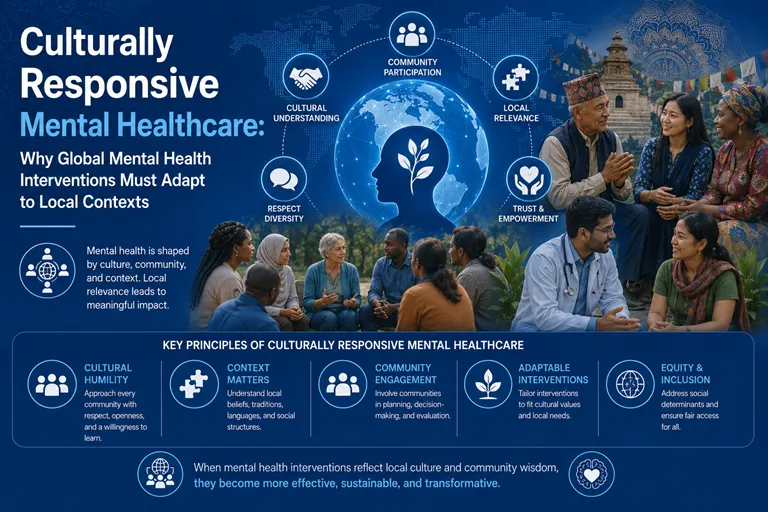
Principles of Culturally Responsive Mental Healthcare
Respect for cultural diversity
Mental health systems must recognise and respect the diversity of cultural perspectives rather than imposing uniform models.
Community-centred approaches
In many societies, mental health is understood collectively. Effective interventions should:
- Involve families and communities
- Leverage local support networks
- Promote collective wellbeing
Integration of traditional and modern practices
Combining biomedical approaches with traditional healing systems can enhance:
- Cultural acceptance
- Treatment adherence
- Holistic care
Flexibility and adaptation
Interventions should be adaptable to:
- Language differences
- Socioeconomic conditions
- Local health infrastructure
Cultural Adaptation of Psychological Interventions
Adapting evidence-based therapies
Therapies such as cognitive behavioural therapy (CBT) can be adapted by:
- Using culturally relevant examples
- Incorporating local metaphors and narratives
- Adjusting communication styles
Language and communication
Effective communication requires:
- Translation beyond literal meaning
- Understanding cultural nuances
- Use of culturally appropriate terminology
Training culturally competent practitioners
Mental health professionals must be trained to:
- Recognise cultural differences
- Avoid bias
- Engage respectfully with diverse populations
The Role of Community and Local Systems
Community-based mental health care
In many Global South settings, mental health services are delivered through:
- Community health workers
- Local organisations
- Peer support networks
These systems are often more accessible and culturally aligned.
Importance of local leadership
Community leaders, traditional healers, and local stakeholders play a crucial role in:
- Building trust
- Facilitating engagement
- Supporting implementation
Policy Implications for Culturally Responsive Care
Designing inclusive policies
Mental health policies must:
- Reflect cultural diversity
- Address local needs
- Include community input
Bridging policy and practice
Research should focus on how policies are implemented in real-world contexts, ensuring that they translate into effective services.
Equity and access
Culturally responsive care is essential for reducing disparities and ensuring equitable access to mental health services.
Technology and Cultural Responsiveness
Opportunities in digital mental health
Digital tools can support culturally responsive care by:
- Providing localised content
- Reaching underserved populations
- Offering flexible access to services
Challenges in digital adaptation
However, digital solutions must address:
- Language barriers
- Cultural relevance
- Accessibility issues
Without adaptation, technology may reinforce existing inequalities.
Research Directions in Cultural Mental Health
Participatory and community-based research
Engaging communities in research ensures that:
- Studies address real needs
- Interventions are contextually relevant
Interdisciplinary approaches
Cultural mental health research benefits from collaboration across:
- Psychology
- Anthropology
- Sociology
- Public health
Expanding Global South scholarship
Encouraging research from diverse regions helps build a more inclusive knowledge base.
The Role of Journals in Promoting Cultural Responsiveness
Academic journals have a responsibility to:
- Publish culturally diverse research
- Support Global South authors
- Encourage interdisciplinary dialogue
- Promote ethical research practices
The International Journal of Global Mental Health, Innovation, Policy, Action, Culture & Transformation (IMPACT) actively supports research that reflects cultural diversity and real-world impact.
A Note for Institutions Developing Mental Health Journals
Institutions aiming to create new journals in this field should prioritise:
- Inclusive editorial policies
- Diverse editorial boards
- Strong submission and review systems
- ISSN and DOI readiness
Modern platforms like ScholarJMS, supported by OJSCloud and GetDOI, can help institutions build journals that are both technically strong and academically credible.
Frequently Asked Questions (FAQs)
What is culturally responsive mental healthcare?
It is an approach that adapts mental health services to align with the cultural beliefs, values, and needs of individuals and communities.
Why is cultural context important in mental health?
Cultural context shapes how mental health is understood, expressed, and treated, making it essential for effective care.
Can Western therapies be used globally?
Yes, but they must be adapted to local cultural contexts to ensure relevance and effectiveness.
What role do communities play in mental health care?
Communities provide support, influence beliefs, and play a key role in delivering accessible and culturally appropriate care.
How can technology support culturally responsive care?
Technology can expand access and provide localised interventions, but it must be carefully adapted to cultural and linguistic contexts.
Conclusion
Culturally responsive mental healthcare is fundamental to the future of global mental health. Moving beyond one-size-fits-all models requires a deep understanding of cultural context, community dynamics, and local realities.
By adapting interventions, engaging communities, and promoting inclusive research, the global mental health field can develop solutions that are both effective and equitable.
The International Journal of Global Mental Health, Innovation, Policy, Action, Culture & Transformation (IMPACT) remains committed to advancing culturally grounded research that bridges knowledge and action.
Researchers, practitioners, and institutions are encouraged to contribute to this evolving field and help shape a more inclusive and responsive mental health landscape.