
Community-Based Mental Health Interventions: Models, Evidence, Equity, and Research Priorities
Community-Based Mental Health Interventions: Models, Evidence, Equity, and Research Priorities
Introduction: Reimagining Mental Health Care Through Communities
Mental health care is undergoing a critical transformation. Traditional models that rely heavily on specialised institutions and clinical professionals are increasingly being complemented and, in some contexts, replaced by community-based approaches.
In 2026, community-based mental health interventions are recognised as essential for:
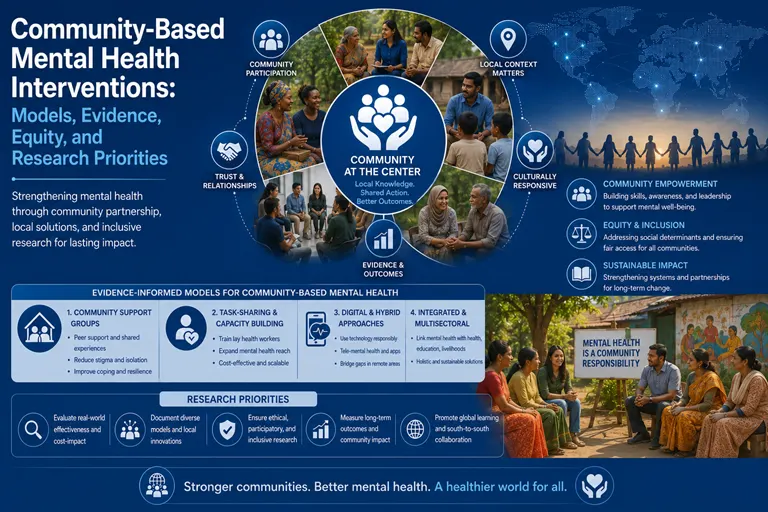
- Expanding access to care
- Addressing resource constraints
- Enhancing cultural relevance
- Promoting equity and inclusion
Particularly in low- and middle-income countries, and in underserved populations globally, community-based models provide practical, scalable, and sustainable solutions.
The International Journal of Global Mental Health, Innovation, Policy, Action, Culture & Transformation (IMPACT) supports research that connects community action with evidence-based mental health interventions, ensuring real-world impact.
Understanding Community-Based Mental Health Interventions
What are community-based interventions?
Community-based mental health interventions are programmes and services delivered within community settings rather than institutional environments such as hospitals.
They focus on:
- Accessibility and local engagement
- Prevention and early intervention
- Social support and collective wellbeing
- Integration with existing community structures
Key characteristics
- Delivered close to where people live
- Involvement of non-specialist providers
- Emphasis on culturally relevant practices
- Focus on holistic wellbeing
Major Models of Community-Based Mental Health Care
Task-sharing and task-shifting models
Task-sharing involves distributing mental health care responsibilities among:
- Community health workers
- Nurses and primary care providers
- Peer supporters
This approach addresses the shortage of specialised professionals.
Peer support and lived-experience models
Peer support programmes involve individuals with lived experience of mental health challenges providing support to others.
Benefits include:
- Increased empathy and understanding
- Reduced stigma
- Improved engagement
School- and workplace-based interventions
Community-based care extends to institutions such as:
- Schools
- Universities
- Workplaces
These settings allow for:
- Early identification of mental health issues
- Preventive interventions
- Awareness and education programmes
Integrated primary care models
Mental health services are integrated into primary healthcare systems, enabling:
- Holistic care
- Reduced stigma
- Improved accessibility
Evidence Supporting Community-Based Approaches
Effectiveness in low-resource settings
Research shows that community-based interventions can:
- Improve mental health outcomes
- Increase service coverage
- Reduce treatment gaps
Cost-effectiveness
Community models are often more affordable because they:
- Utilise existing infrastructure
- Reduce reliance on specialists
- Focus on prevention
Improved patient engagement
People are more likely to engage with services that are:
- Accessible
- Culturally relevant
- Delivered by trusted community members
Advancing Mental Health Equity Through Community Care
Addressing disparities in access
Community-based interventions help reach:
- Rural populations
- Marginalised communities
- Low-income groups
Reducing stigma
Localised programmes promote:
- Awareness and education
- Normalisation of mental health discussions
- Community support
Empowering communities
Community involvement fosters:
- Ownership of mental health initiatives
- Sustainable change
- Collective resilience
Cultural Relevance and Local Adaptation
Importance of cultural context
Effective interventions must align with:
- Local beliefs and values
- Language and communication styles
- Social norms
Integrating traditional practices
In many communities, traditional healers and cultural practices play a key role in mental health care.
Integrating these with modern approaches can enhance effectiveness.
Challenges in Implementing Community-Based Interventions
Workforce training and support
Non-specialist providers require:
- Proper training
- Ongoing supervision
- Support systems
Quality and consistency
Ensuring consistent quality across diverse settings can be challenging.
Sustainability
Long-term success depends on:
- Funding
- Policy support
- Community engagement
Research Priorities in Community Mental Health
Evaluating long-term outcomes
More research is needed to assess:
- Sustainability of interventions
- Long-term impact on mental health
Scaling successful models
Identifying and replicating effective programmes across regions is a key priority.
Integrating technology
Digital tools can support community interventions through:
- Training
- Monitoring
- Service delivery
The Role of Policy in Supporting Community Interventions
Policy integration
Governments must integrate community-based approaches into national mental health policies.
Resource allocation
Adequate funding and support are essential for scaling programmes.
Cross-sector collaboration
Effective implementation requires collaboration across:
- Health systems
- Education
- Social services
- Community organisations
The Role of Academic Journals in Advancing Community Mental Health
Academic journals play a crucial role in:
- Publishing evidence-based research
- Sharing best practices
- Highlighting innovative models
- Promoting Global South perspectives
The International Journal of Global Mental Health, Innovation, Policy, Action, Culture & Transformation (IMPACT) encourages submissions that focus on community-driven mental health solutions and real-world impact.
A Note for Institutions Building Community-Focused Journals
As interest in community mental health grows, institutions are establishing specialised journals to publish research in this field.
To build a credible journal, it is important to ensure:
- Structured manuscript submission systems
- Transparent peer review workflows
- ISSN and DOI readiness
- Scalable publishing infrastructure
Modern platforms like ScholarJMS, supported by OJSCloud and GetDOI, can help institutions create strong and sustainable journal ecosystems.
Frequently Asked Questions (FAQs)
What are community-based mental health interventions?
They are mental health services delivered within community settings, focusing on accessibility, prevention, and local engagement.
Why are community-based approaches important?
They expand access, reduce costs, and improve cultural relevance, especially in underserved populations.
What is task-sharing in mental health?
It involves distributing mental health care tasks among non-specialist providers to address workforce shortages.
Are community-based interventions effective?
Yes, research shows they can improve outcomes and reduce treatment gaps, particularly in low-resource settings.
What are the main challenges in implementation?
Challenges include training, quality control, funding, and long-term sustainability.
Conclusion
Community-based mental health interventions represent a powerful shift toward more inclusive, accessible, and culturally relevant care systems. By focusing on local engagement, equity, and sustainability, these models address many of the limitations of traditional approaches.
As global mental health continues to evolve, community-driven solutions will play an increasingly important role in shaping effective and equitable systems of care.
The International Journal of Global Mental Health, Innovation, Policy, Action, Culture & Transformation (IMPACT) remains committed to advancing research that connects evidence with action and promotes meaningful change in mental health systems worldwide.
Researchers, practitioners, and institutions are encouraged to contribute to this growing field and support the development of community-based mental health solutions.