
Artificial Intelligence and Digital Innovation in Global Mental Health: Opportunities, Ethics, and Research Challenges
Artificial Intelligence and Digital Innovation in Global Mental Health: Opportunities, Ethics, and Research Challenges
Introduction: The Digital Transformation of Mental Health Care
Global mental health is entering a new era shaped by rapid technological advancement. Artificial intelligence (AI), digital platforms, and data-driven tools are redefining how mental health services are delivered, accessed, and studied.
In 2026, digital innovation is not just enhancing traditional mental healthcare systems; it is fundamentally transforming them. From AI-powered screening tools to tele-mental health platforms and mobile-based interventions, technology is expanding the reach of mental health services across geographical, cultural, and economic boundaries.
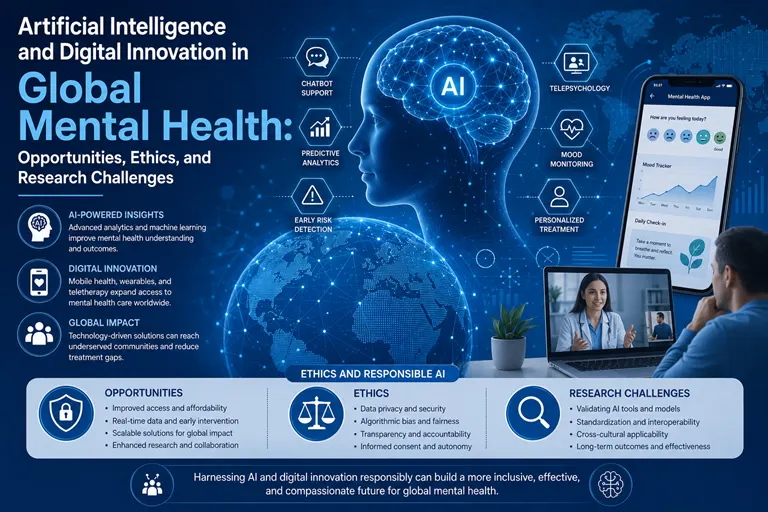
However, alongside these opportunities come critical ethical, social, and research challenges that must be carefully addressed.
The International Journal of Global Mental Health, Innovation, Policy, Action, Culture & Transformation (IMPACT) recognises the importance of this transformation and encourages interdisciplinary research that critically examines both the potential and limitations of digital mental health.
The Expanding Role of Artificial Intelligence in Mental Health
AI for early detection and diagnosis
AI systems are increasingly being used to analyse behavioural, linguistic, and physiological data to identify early signs of mental health conditions.
Applications include:
- Natural language processing to detect emotional distress in text or speech
- Machine learning models analysing social media patterns
- Predictive analytics for identifying high-risk individuals
These tools have the potential to support early intervention, particularly in regions with limited access to mental health professionals.
Personalised treatment and decision support
AI is enabling more personalised approaches to mental healthcare by:
- Recommending tailored treatment plans
- Supporting clinical decision-making
- Analysing patient response to interventions over time
Such approaches move beyond generic treatment models toward more adaptive and responsive care systems.
Digital Mental Health Platforms and Tele-Services
Growth of tele-mental health
Tele-mental health has become a critical component of healthcare delivery, particularly in:
- Rural and remote areas
- Low-resource settings
- Crisis and emergency contexts
Research is focusing on:
- Effectiveness compared to in-person therapy
- Patient satisfaction and engagement
- Long-term outcomes
Mobile applications and digital therapeutics
Mobile-based mental health solutions are expanding rapidly, offering:
- Self-guided therapy modules
- Cognitive behavioural therapy (CBT) tools
- Mood tracking and monitoring
- Psychoeducation resources
These tools increase accessibility but require rigorous evaluation to ensure clinical validity.
Opportunities for Global Mental Health Systems
Expanding access to underserved populations
Digital tools can bridge gaps in mental healthcare by:
- Reaching populations without access to specialists
- Reducing stigma through anonymous support
- Providing scalable interventions
This is particularly relevant in Global South contexts where mental health infrastructure may be limited.
Enhancing efficiency and scalability
AI and automation can:
- Reduce administrative burden on clinicians
- Optimise resource allocation
- Enable large-scale data analysis
Supporting research and data collection
Digital platforms allow researchers to collect real-time data on:
- Patient behaviour
- Treatment outcomes
- Population-level mental health trends
This enhances the evidence base for policy and intervention.
Ethical Challenges in AI-Driven Mental Health
Data privacy and confidentiality
Mental health data is highly sensitive. Digital systems must ensure:
- Secure data storage
- Confidential handling of patient information
- Compliance with data protection regulations
Algorithmic bias and fairness
AI systems may reflect biases present in training data, leading to:
- Misdiagnosis in underrepresented populations
- Inequitable treatment recommendations
Addressing bias is essential for ethical AI deployment.
Informed consent and transparency
Users must understand:
- How their data is being used
- Limitations of AI systems
- Risks associated with digital tools
Transparency builds trust and accountability.
Cultural and Contextual Considerations
Limitations of universal digital solutions
Digital mental health tools are often developed in Western contexts and may not align with:
- Cultural beliefs about mental health
- Local languages and communication styles
- Community-based care practices
Need for culturally adaptive technologies
Research is focusing on:
- Localising digital content
- Incorporating cultural frameworks
- Designing inclusive user interfaces
This ensures that technology is relevant and effective across diverse populations.
Research Challenges in Digital Mental Health
Evidence generation and validation
Many digital tools lack:
- Rigorous clinical trials
- Long-term outcome studies
- Standardised evaluation frameworks
Researchers must establish robust methodologies to assess effectiveness.
Interdisciplinary collaboration
Digital mental health requires collaboration between:
- Psychologists and clinicians
- Data scientists and engineers
- Public health experts
- Policymakers
Regulatory and policy frameworks
Governments and institutions must develop policies that address:
- Safety and efficacy of digital tools
- Ethical use of AI
- Integration into healthcare systems
The Role of Journals in Advancing Digital Mental Health Research
Academic journals play a critical role in:
- Publishing evidence-based research
- Encouraging interdisciplinary dialogue
- Promoting ethical standards
- Highlighting Global South perspectives
The International Journal of Global Mental Health, Innovation, Policy, Action, Culture & Transformation (IMPACT) is committed to supporting research that explores both innovation and responsibility in digital mental health.
A Note for Institutions Developing Digital Mental Health Journals
As digital mental health research grows, many institutions are launching specialised journals in this field.
To support such initiatives, it is important to ensure:
- A structured manuscript submission system
- Efficient peer review workflows
- ISSN and DOI readiness
- Scalable publishing infrastructure
Modern platforms like ScholarJMS, supported by OJSCloud and GetDOI, can help institutions build professional and sustainable journal ecosystems.
Frequently Asked Questions (FAQs)
How is AI used in mental health research?
AI is used for early detection, predictive analytics, personalised treatment planning, and large-scale data analysis.
What are digital mental health interventions?
They include mobile apps, tele-therapy, online counselling, and digital therapeutic tools designed to support mental health.
What are the main ethical concerns in AI mental health tools?
Key concerns include data privacy, algorithmic bias, lack of transparency, and potential misuse of sensitive information.
Are digital mental health tools effective?
Many tools show promise, but more research is needed to establish long-term effectiveness and clinical validity.
Can technology replace mental health professionals?
Technology is intended to complement, not replace, human professionals by improving access and efficiency.
Conclusion
Artificial intelligence and digital innovation are reshaping global mental health in unprecedented ways. These technologies offer powerful tools to expand access, improve efficiency, and generate new insights into mental health.
However, their success depends on addressing ethical concerns, ensuring cultural relevance, and maintaining rigorous research standards.
As the field continues to evolve, collaboration between researchers, practitioners, policymakers, and technologists will be essential.
The International Journal of Global Mental Health, Innovation, Policy, Action, Culture & Transformation (IMPACT) invites researchers to contribute to this critical area of study and help shape the future of ethical and inclusive digital mental health.